No one has seen this
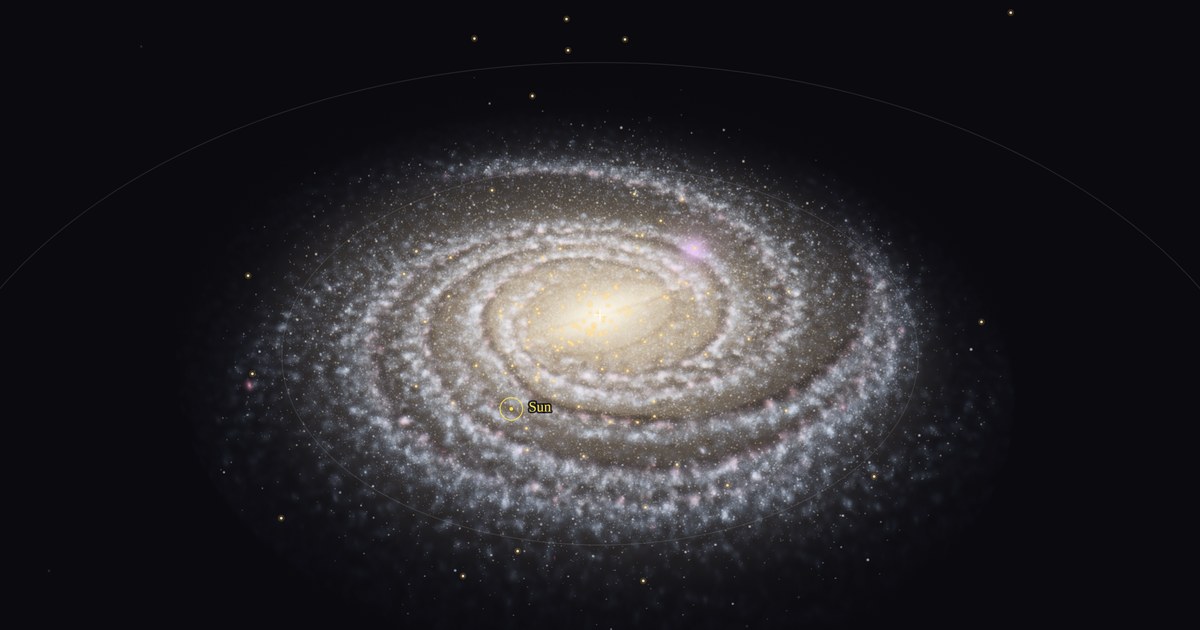
There is no photograph of the Milky Way from outside, and there will be none for a very long time. We live inside the disk, a little over halfway out from the center, and see our Galaxy only as a band of light across the night sky. What you are turning here is a reconstruction. Every part of it is placed by a published measurement and, where measurement stops, by the simplest continuation of what was measured.
It is drawn the way a telescope would gather it, as light and the dust that blocks light: the warm glow of old stars, the blue of young ones, the pink of clouds where stars are forming, and dark lanes that dim whatever lies behind them. Scattered through the glow are a few hundred thousand points of light. Each one stands for half a million stars or more.
What is measured, and what is inferred
Switch on Only what has been measured. The reconstruction dims, and two things stay lit. The bright lines are stretches of spiral arm whose distances have been measured directly, by radio telescopes that watch about two hundred star-forming regions shift back and forth as the Earth circles the Sun. The blue glow around the Sun is where the Gaia spacecraft has mapped young stars one by one. Together they cover a modest part of the near side. The rest of the disk, and nearly all of the far side, is continued from them.
So the arms you see beyond the center follow real arms, measured where we can reach them and extended by the same curve where we cannot. Whether the Galaxy has four great arms or two, and how they join the bar of old stars that runs through the center, is still argued. The bar itself is well established from counts of old stars, and so is the warp of the outer disk, traced by pulsating stars whose distances are known. The colors, the dust lanes and the knots of pink are illustration: they show what kinds of thing lie where, not a measured picture. So is everything finer than the arms themselves. The clumps, threads and feathers are laid along the measured curves by rule, the same way every time the page is built, and no telescope has seen them.
The globular clusters and the other galaxies are a different matter. Each is a single object with a measured position and distance, placed exactly where the catalogues put it.
The household
Tilt the Galaxy edge-on and it is thin, a thousand light-years thick across most of a disk a hundred thousand wide, with a swelling at the center and a gentle twist at the rim. Around it hangs a sphere of some hundred and fifty globular clusters, each a ball of ancient stars, most of them older than the disk itself.
Farther out are the satellites: more than sixty small galaxies held by the Milky Way’s gravity. The two largest, the Magellanic Clouds, are visible to the naked eye from the south. One, the Sagittarius dwarf, is being taken apart as we watch. Zoom out again and Andromeda comes into view with a household of its own, two and a half million light-years away and slowly approaching.
That is the whole of it. Beyond this small group nearly every galaxy is being carried away from us by the expansion of the universe. The first page says the Milky Way and its companions are all there is for us. This is what that looks like.
The measure of it
The view opens on the part of this picture that is measured, not reconstructed: the dust and bright stars within 1,600 light-years of the Sun, the same data as the Kiloparsec page, set in its true place in the disk. As the view draws back, that whole map shrinks to the small gold ring around the Sun. Everything on the Neighborhood page would be a speck at its center, far too small to draw. Where we live returns there.
The dotted circle is the Sun’s path around the Galaxy. One circuit takes about 212 million years; since the dinosaurs died, the Sun has gone not quite a third of the way around.
How this map was made
- Spiral arms. Reid et al. (2019), trigonometric parallaxes of high-mass star-forming regions, Astrophysical Journal 885, 131: the fitted position, pitch and width of each arm, and the range over which each was measured. Parameters as collected in the SpiralMap library of Prusty and Khanna.
- Young stars near the Sun. Poggio et al. (2021), Galactic spiral structure revealed by Gaia EDR3, Astronomy & Astrophysics 651, A104.
- The bar. Wegg, Gerhard & Portail (2015), Monthly Notices of the Royal Astronomical Society 450, 4050: half-length 5 kiloparsecs (16,000 light-years), turned 28 to 33 degrees from our line of sight. The bulge around its middle keeps the proportions measured by Wegg & Gerhard (2013), Monthly Notices of the Royal Astronomical Society 435, 1874: ten long, 6.3 wide, 2.6 thick.
- The disk. Bland-Hawthorn & Gerhard (2016), Annual Review of Astronomy and Astrophysics 54, 529: the Sun 8.2 kiloparsecs (26,700 light-years) from the center, in a disk that fades by a fixed fraction every 2.6 kiloparsecs, with most of its old stars within about a thousand light-years of the middle plane.
- The warp. Chen et al. (2019), Nature Astronomy 3, 320, from classical Cepheids.
- The Sun’s surroundings. The dust map of Wang and colleagues (2025) and the AT-HYG star catalogue, prepared as described on the Kiloparsec page.
- Globular clusters and galaxies. The Local Volume Database of Pace (2024), which includes the Harris catalogue of globular clusters. Andromeda and Triangulum are placed at 2.5 and 2.8 million light-years.