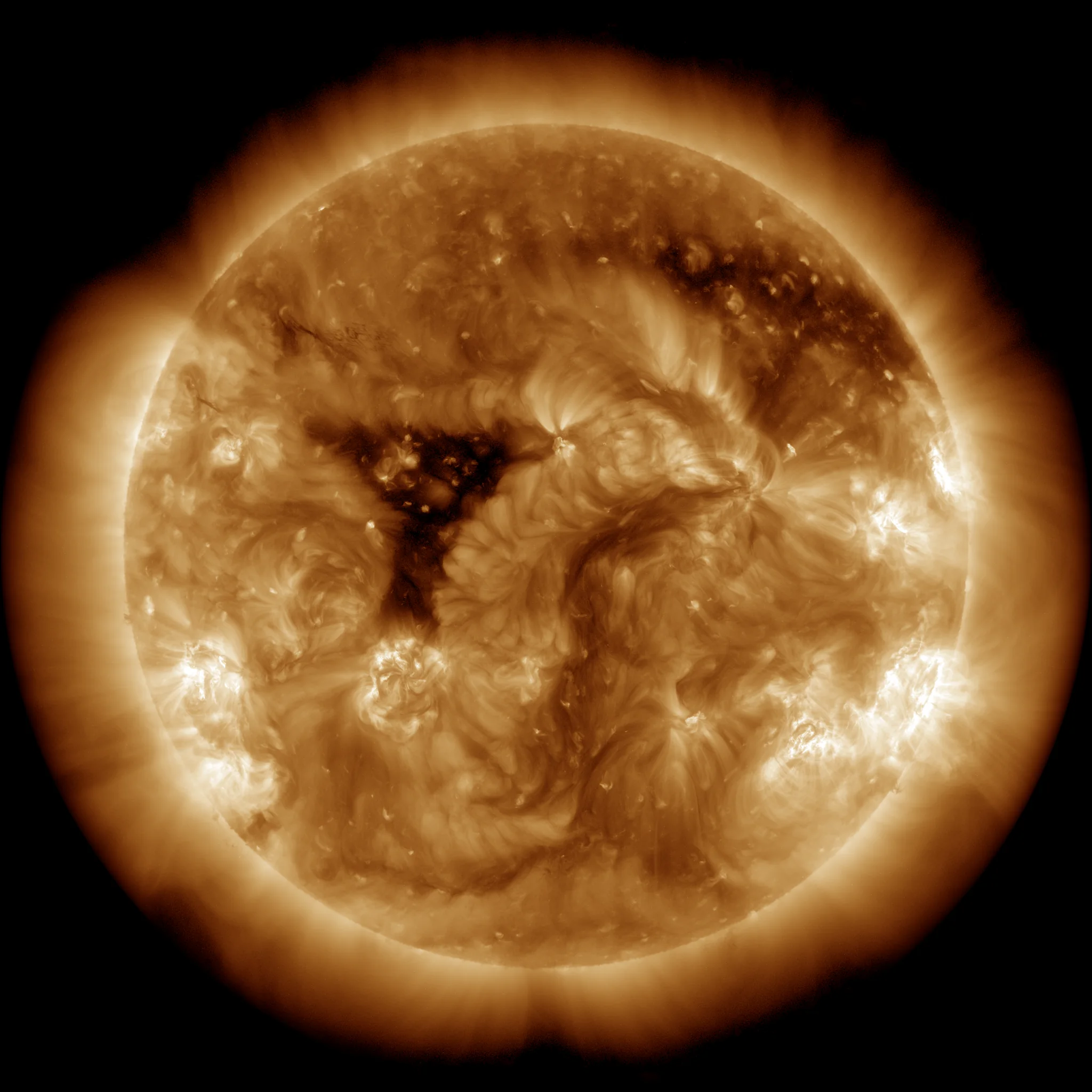
One star, up close
The page opens on the Sun as a spacecraft saw it, in light the eye cannot see. Everywhere else on this site a star is a point. This is the one star we can look at, and it is worth a long look, because every one of those points is something like it.
The Sun gives off 3.8 × 1026 watts: about nine billion billion gigawatt-hours every day, and nearly twenty trillion times what all of human industry uses. The Earth, a hundred and fifty million kilometers away, catches one part in 2.2 billion of that, and that sliver drives the weather, the oceans and every living thing. All of human industry runs on about one part in nine thousand of the sliver. The eight planets together catch about four billionths of the Sun’s light. The rest leaves the Solar System unused.
Now draw back, with Next or the minus button, and watch what happens to it. The Sun is 109 Earths wide, yet by the time the Earth’s orbit fits on the screen the Sun is barely a pixel across, and the dot that marks it is far larger than it should be. The Earth circles about a hundred Sun-widths away. The Moon is thirty Earth-widths from the Earth. Travel on to the Moon or to Mars and the view has to close in by a factor of a hundred thousand before either becomes more than a point. Nearly all of the Solar System is the space between.
Two things carry over to every other star as the maps pull back: the light is enormous, and almost all of it goes uncaught. A settlement around another star does not need that star to have an Earth. It needs light, and even a dim star gives off billions of times more than our whole civilization uses.
Where the mass is
The Sun holds 99.86 percent of the Solar System’s mass. Of what remains, Jupiter is more than two-thirds and the four giant planets together are over 99 percent. The Earth is a fifth of one percent of the planets. Travel to Everything, choose Mass, and it all but disappears.
Mass at the bottom of a deep gravity well is hard to use, though, and most of any planet lies out of reach beneath its own surface. What a builder can use is the small stuff: asteroids, comets and little moons, which can be taken apart where they are, and the surface of our own Moon, whose pull is weak. There is less of it than one might guess, and it goes further. The whole asteroid belt weighs three percent of the Moon. Spread ten tonnes to the square meter, which is the weight of air that shields each square meter of the Earth from space, it would roof about fifteen hundred times the Earth’s land area. That is our arithmetic, not a design.
Farther out there is far more. The Kuiper belt beyond Neptune holds about fifty times the asteroid belt’s mass in ice and rock. The Oort cloud, which no one has seen and whose size is inferred from the comets that fall out of it, may hold a hundred times more again.
Rock is not what runs short. Our finding on building material puts the limit at nitrogen, about two tonnes for every person, nearly all of it as air. Choose Nitrogen to see where the Solar System keeps what has been measured: in the air of Venus, Earth and Titan, and frozen on Pluto. Fuel is less of a limit still. Deuterium, the heavy form of hydrogen that fusion engines would burn, is in all water ice, and the giant planets hold the other fusion fuel, helium-3, ready-made. The fuel finding works through what that does and does not buy.
The Moon and Mars
Two of the stops are worlds people could stand on. Both are drawn as they are at the moment you opened the page: the Moon in tonight’s phase, with craters catching the light along the edge of its shadow, and Mars showing the face it is turning toward the Earth.
The Moon is more than a place to learn to live off the Earth. It is seventy-three billion billion tonnes of rock, thirty times the mass of the whole asteroid belt, three days away and already most of the way out of the Earth’s gravity. Lifting a kilogram from its surface into open space takes about a twentieth of the energy it takes from the Earth, and there is no air in the way, so its rock could be thrown off by electric launchers instead of rockets, as studies since the 1970s have proposed. That rock is about two-fifths oxygen by weight, and most of the rest is silicon, iron, aluminum and other metals. There is ice in craters at its poles that never see the Sun.
Put those together with the light streaming past. A collector as wide as the Earth would catch nine thousand times the power our civilization uses. At a kilogram to the square meter it would weigh no more than the top two millimeters of the Moon’s soil. That is our arithmetic, not a design, but it shows the scale of what a civilization working from the Moon has within reach.
Mars has a different place: it is where the people of that civilization can live. It is the nearest world with water ice at its poles and under its ground, carbon and oxygen in its air, rock to shelter under, a day of twenty-four hours and thirty-seven minutes and a little over a third of the Earth’s gravity. None of that makes it a second Earth. Its air is far too thin to breathe and holds very little nitrogen, about a nine-thousandth of the Earth’s, so a large settlement would have to bring more from the cold outer system. Living there means building the whole environment and keeping it running, with machines doing much of the work.
That is the point. No star within reach is known to have a world people could simply walk out onto, so a people who can make Mars live will have learned most of what Alpha Centauri will ask of them. It is also why this project expects the first starships to come from Mars. Such a society would already mine and build in space, and already keep people alive in habitats of its own making. Sunlight there is less than half as strong as at the Earth and dust storms can dim it for weeks, so it would lean on nuclear power and have every reason to master it, and a starship’s engine is a nuclear engine. And it would be a frontier society, used to going farther than anyone has gone.
What a neighbor would see
Now turn it around. At Everything, choose What Alpha Centauri could see. If astronomers at the nearest star had instruments like ours, they would know the Sun well: from there it is one bright star in the constellation Cassiopeia. They would find Jupiter, because it swings the Sun back and forth by about the Sun’s own width every twelve years, and that is measurable across four light-years. With decades of patience they might find Saturn. They would not find the Earth. They would see no asteroid belt and nothing of the Oort cloud, and a belt like our Kuiper belt would be thousands of times too faint for them.
That is where we stand when we look outward. On the maps that follow, each star is a point with at most a few known planets beside it. Those points are not empty. We cannot yet see what they hold, and this page is the nearest thing anyone has to an inventory of one.
Not known. What could be found from Alpha Centauri is our judgment from the published limits of today’s instruments, not a study. The mass of the Oort cloud is uncertain by more than a factor of ten. How much nitrogen the comets and the giant planets’ moons hold has barely been measured.
How this page was made
The Sun is an image from NASA’s Solar Dynamics Observatory, taken in extreme ultraviolet light at a wavelength of 19.3 nanometers and colored by the mission’s usual convention. When the page can fetch it, you see the observatory’s latest image, passed through this site so that your browser contacts no one else. Otherwise you see a stored image from 24 June 2013. The caption says which.
The Moon is a shadow-free map of its surface wrapped on a sphere and lit from where the Sun is now, with relief computed from an elevation map and exaggerated threefold so that it shows at this size. Mars is the United States Geological Survey’s mosaic of Viking orbiter images. Phase, distance and the way each body is turned are computed when the page opens: the Moon’s from the main terms of its motion and the planets’ from E. M. Standish’s mean orbital elements, both good to a small fraction of a degree. Mars’s clouds, dust and seasonal frost are not drawn.
From the Sun out to the Kuiper belt the page keeps one scale: sizes and distances are both true, and the view is a map seen from straight above the planets’ orbits. Each travel between stops zooms at a steady rate, so the time it takes is a fair measure of the gap. Close up, the Sun, the Moon and Mars each show the face they turn toward the Earth, set where the body is on that map, so the lit side of a globe need not point at the Sun’s dot. Until a body is larger than its marker, the marker is all you see.
The last stop cannot keep the scale. The nearest star is nine thousand times farther than Neptune, so at Everything the map turns logarithmic, and you can watch it do so: the planets spread out from the center while the edge of the view stays where it was. From there the rings look evenly spaced, but each is many times wider than the one inside it. Directions stay true. The asteroid and Kuiper belts are drawn as plain bands between their usual limits, and the Oort cloud, which has never been observed, as a faint shell.
Masses and sizes are from NASA’s planetary fact sheets, and the masses of the two belts from Pitjeva and Pitjev (2018), who weighed them by their pull on the planets. The sunlight each body catches is our arithmetic from its size and distance. The nitrogen figures for Venus and Titan are our arithmetic from measured pressure, gravity and composition; Mars’s is from the Curiosity rover; Pluto’s is a floor from the area and least depth of one ice sheet. Human energy use is taken as twenty trillion watts. The collector weighed against the Moon’s soil is taken at one kilogram to the square meter, and the soil at one and a half tonnes to the cubic meter.